
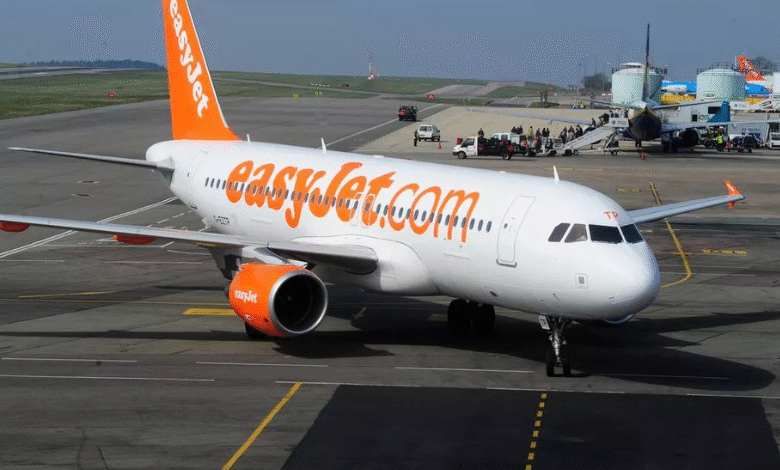
On 22 August 2025, EasyJet flight U24429, operating an Airbus A320 (registration OE-IJL), made headlines after declaring an in-flight emergency shortly after takeoff. The aircraft departed from Lyon-Saint Exupéry Airport (France) bound for Porto, Portugal, but was forced to return to Lyon after a disturbing onboard incident.
The situation escalated quickly: while the aircraft was ascending, the crew declared the international distress code “7700”, signaling a general emergency. AeroHaber+2Travel And Tour World+2 Rather than continue the climb, the plane leveled off at altitude, then reversed course and landed back at Lyon approximately 45 minutes after takeoff.
Cause of the Emergency: Passenger in Psychotic State
According to official reports, the cause of the emergency was not technical, but behavioral. A 26-year-old Portuguese passenger reportedly entered a psychotic state and attempted to break into the cockpit shortly after takeoff.
The individual was restrained by members of the cabin crew and several passengers until the aircraft returned to the ground. traveltomorrow.com+1 Upon landing at Lyon, police boarded the aircraft, arrested the passenger, and escorted him off.
Subsequent medical evaluation reportedly revealed that the man was suffering from a combination of airsickness and an acute psychotic disorder. After his removal, easyJet confirmed that the flight eventually continued to Porto later that same evening.
Safety Protocols & Response by EasyJet Crew
EasyJet’s crew response demonstrates the airline’s commitment to passenger and flight deck safety:
-
The crew immediately declared a code 7700 emergency, triggering priority handling from air traffic control.
-
Cabin crew and other passengers acted quickly to subdue and restrain the disruptive individual, preventing a potential cockpit breach.
-
Emergency teams were on standby upon landing in Lyon; law enforcement authorities met the aircraft as soon as it touched down.
-
After the man was removed, the airline resumed the flight, indicating the incident was resolved to a level to allow continuation.
Medical Assessment of the Passenger
Authorities later said the passenger exhibited signs of acute psychotic behavior and delirium, possibly linked to a more serious mental health episode. Reports also mention motion sickness (airsickness) as a contributor to his distress.
After landing, he was taken to hospital for psychiatric evaluation and treatment, and was not known to local authorities prior to the incident.
Aircraft and Operational Details
-
Aircraft Model: Airbus A320 Travel And Tour World+1
-
Registration: OE-IJL
-
Departure Airport: Lyon-Saint Exupéry Airport, France traveltomorrow.com
-
Intended Destination: Porto, Portugal
-
Time of Emergency Declaration: Shortly after takeoff, around 20,000 feet of altitude
-
Landing: Returned to Lyon, landed on runway 35R, with emergency services present.
Industry and Airline Reaction
EasyJet confirmed in its statement that the flight had to return due to the behavior of a passenger, and that once the individual was removed, the flight continued its journey to Porto. The Economic Times French police corroborated that the man showed signs of a psychotic episode, necessitating his removal and hospitalization.
Airline safety-governance frameworks anticipate such incidents. According to EasyJet’s safety and governance documentation, they have station emergency response plans (SERPs) in place at each of their operating airports, ensuring that local airport partners and ground handling teams are ready for coordinated responses.
Psychological and Security Implications of the Incident
This event underscores several critical issues for modern aviation:
-
Mental Health in the Sky
The case reveals how acute psychological distress can escalate rapidly on board. Airlines are increasingly focused on crew training to identify and respond to mental health crises mid-flight. -
Security Protocols vs. Passenger Care
While the cabin crew and fellow passengers acted decisively to prevent unauthorized cockpit access, such actions also highlight the complex balance between security concerns and compassionate care, especially when the individual’s behavior is medically driven. -
Emergency Declaration Realities
Declaring a “7700” emergency is reserved for serious threats. In this situation, it was correctly used to ensure priority handling and a prompt return to base, not merely as a precaution. -
Resumption of Service
Remarkably, after the disruptive passenger was removed, the flight resumed. This illustrates airlines’ efforts to minimize disruption for other travellers, but also suggests confidence that the situation was managed without further risk.
Travel Advice and Lessons for Passengers
For travellers concerned about similar incidents, the following takeaways may provide reassurance:
-
Safety Is Priority: Airlines like EasyJet operate rigorous safety regimes. An emergency declaration like 7700 signals that crew and ATC are fully coordinating to handle a threat.
-
Behavioural Risks Are Taken Seriously: Even if the root cause is mental or medical, disruptive behaviour especially attempts to breach the cockpit is handled decisively.
-
Unpredictability of Human Factors: Not all emergencies are technical; passenger welfare issues continue to be among the challenges faced in commercial aviation.
-
Importance of Mental Health Awareness: Passengers with known mental health conditions should consult their doctor before flying, and possibly submit a medical declaration form to the airline if required.
-
Trust in Airline Protocols: EasyJet and other operators maintain emergency response procedures across their route network.
Conclusion
The EasyJet U24429 emergency was a serious but well-managed event. An Airbus A320 returning to Lyon after a passenger in a psychotic state attempted to breach the cockpit highlights the unpredictable nature of in-flight crises. Crucially, the crew’s rapid response, the use of emergency transponder code 7700, and the safe return to the departure airport all point to a solid safety culture.
Such incidents serve as a reminder that airline safety protocols are not just about mechanical reliability they also encompass human factors, mental health, and real-time decision-making under pressure. For passengers, the reassurance lies in seeing how airlines are structured to handle not only the typical technical emergency, but also rare but challenging behavioral emergencies.


